Clinical Monograph 06 · Quantitative Regulatory Audit · 347 mg Total Active Payload
The 347 mg Synbiotic Capsule Math: 21 CFR 101.36 Strain Bounds vs. Multi-Gram Fiber Trials
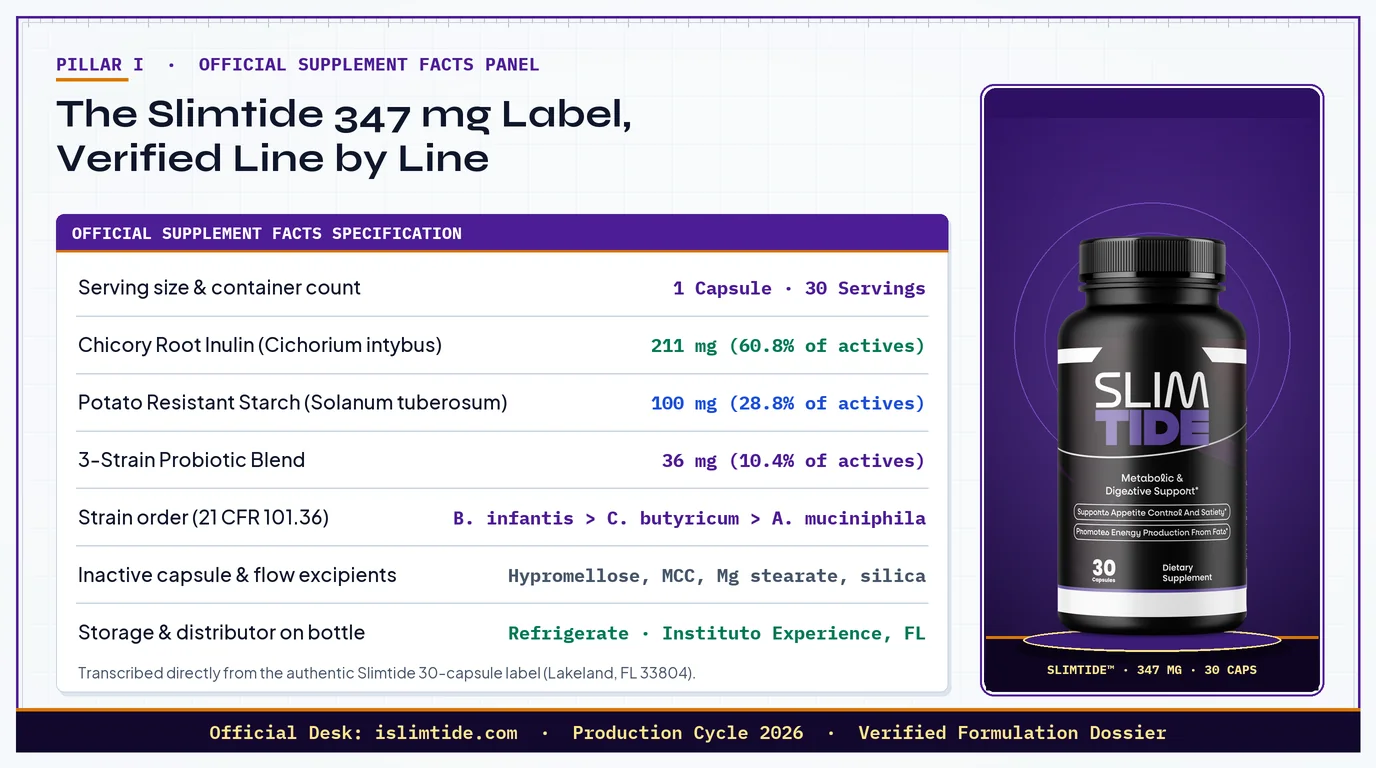
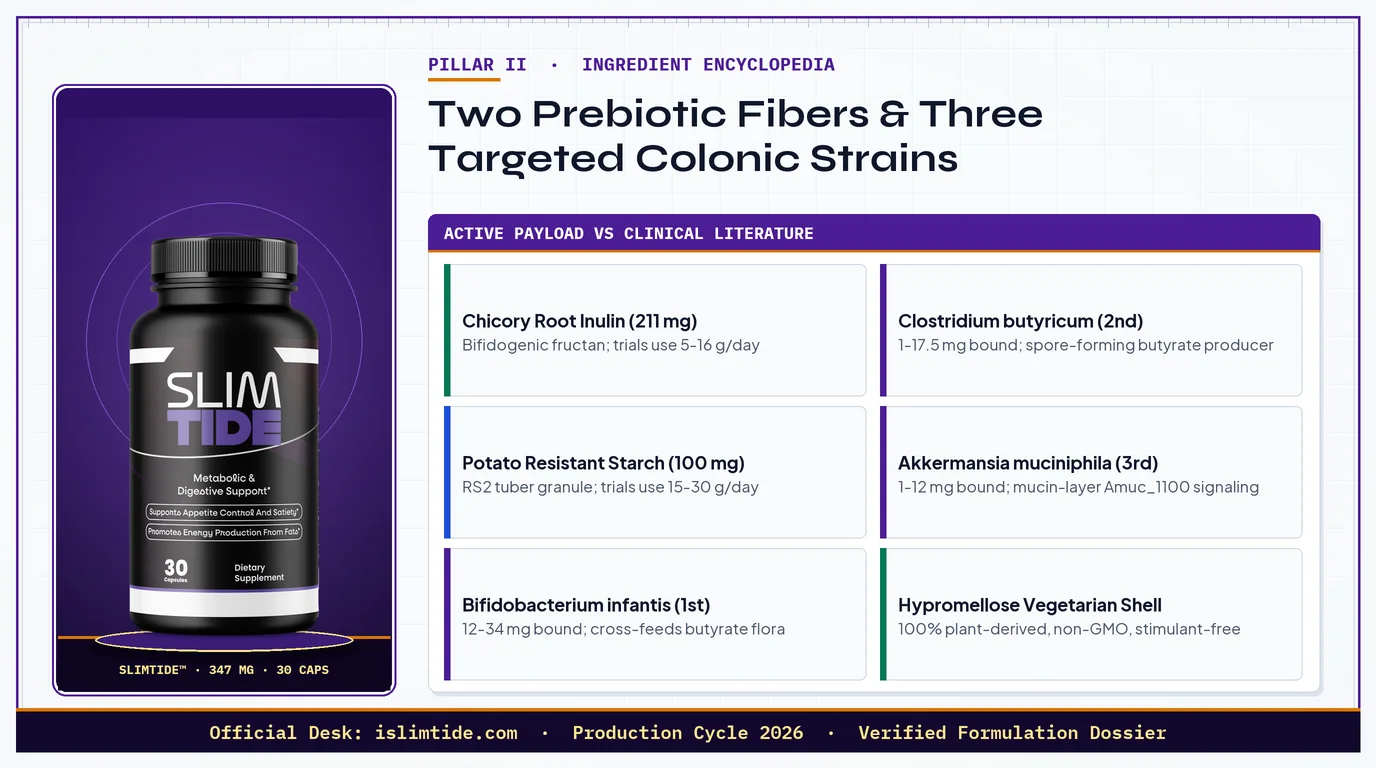
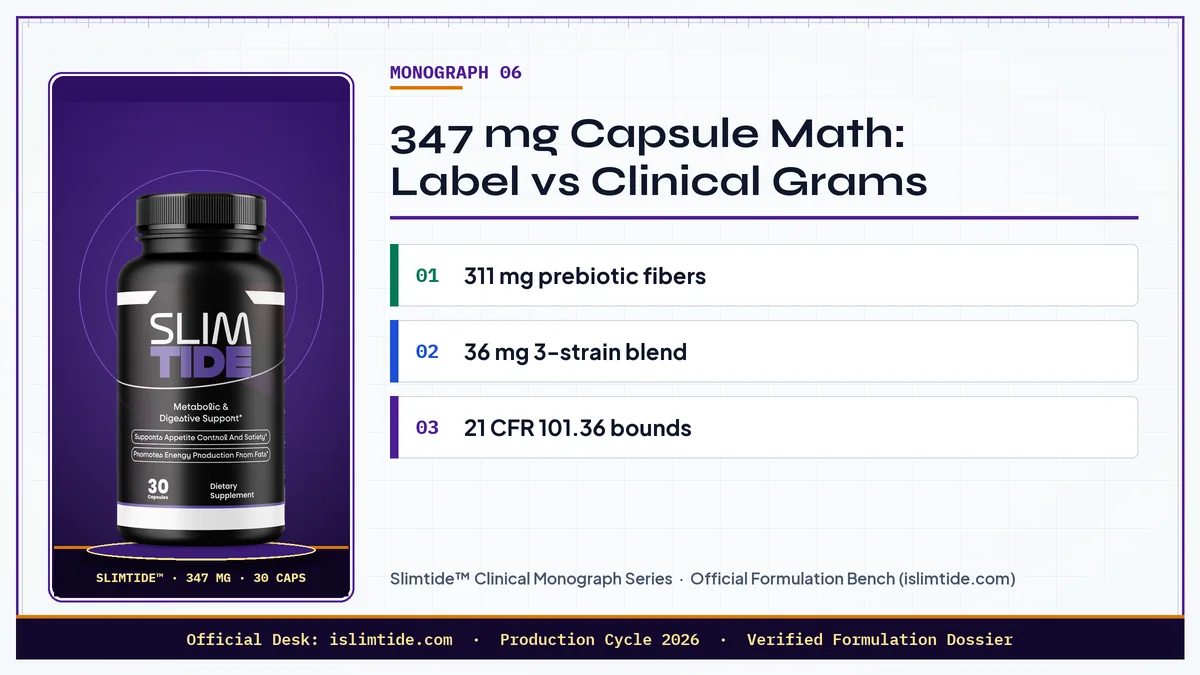
Every once-daily Slimtide vegetarian capsule contains 347 mg of declared active ingredients: 311 mg of prebiotic dietary fibers (211 mg chicory root inulin + 100 mg potato resistant starch) paired with a 36 mg three-strain Probiotic Blend (Bifidobacterium infantis, Clostridium butyricum, and Akkermansia muciniphila) [1,2]. This flagship quantitative monograph reconciles the physical gravimetric geometry of a 347 mg capsule, federal 21 CFR 101.36 proprietary blend bounds, FDA live-microbial labeling guidance, and the exact mathematical ratios between capsule-scale synbiotics and multi-gram clinical fiber trials.
Gravimetric Partition of the 347 mg Active Capsule Payload
When evaluating any dietary supplement under the Dietary Supplement Health and Education Act of 1994 (DSHEA) and 21 CFR 101.36, the first analytical step is summing the printed dietary ingredient declarations to establish the exact active mass budget [2,3]. Unlike products that hide their entire formula behind a single opaque "proprietary complex" number, the Official Slimtide Supplement Facts panel prints exact milligram weights for both prebiotic fibers and a separate milligram weight for the three-strain probiotic consortium [1]:
Official 347 mg Slimtide Capsule Gravimetric Ledger
- Total Active Dietary Payload per 1-Capsule Serving (100.00%)
- 347 mg
- Combined Prebiotic Fiber Matrix (89.63% of Active Mass)
- 311 mg
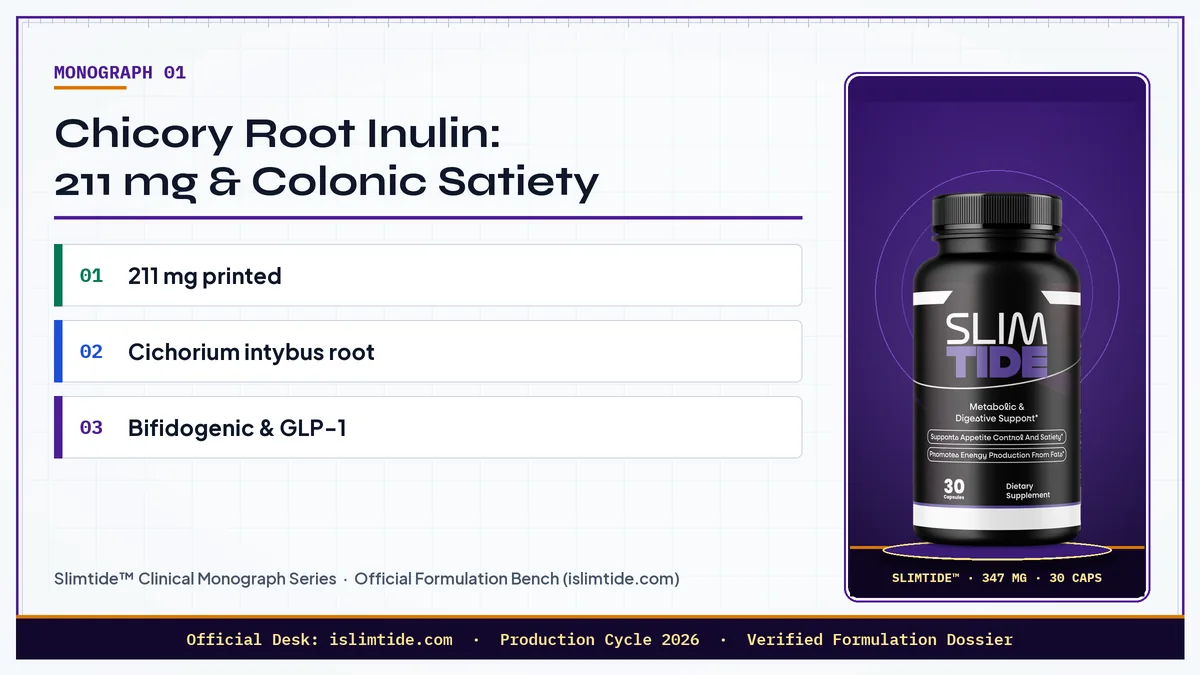
- Chicory Root Inulin (Cichorium intybus root) (60.81% of Active Mass)
- 211 mg
- Potato Resistant Starch (Solanum tuberosum tuber) (28.82% of Active Mass)
- 100 mg
- 3-Strain Probiotic Blend (10.37% of Active Mass; 1 : 8.64 Ratio to Fibers)
- 36 mg
In addition to the 347 mg of active ingredients, the "Other Ingredients" section of the Slimtide label declares four standard pharmaceutical-grade excipients required for high-speed cGMP capsule filling and moisture protection under 21 CFR Part 111 [1,4]:
- Hypromellose (Hydroxypropyl Methylcellulose, HPMC): Vegetarian, plant-cellulose capsule shell (approximately 90 mg to 96 mg shell weight for a standard Size-0 capsule) with lower intrinsic moisture content (3% to 6%) than bovine gelatin (13% to 16%), protecting moisture-sensitive lyophilized probiotics [1,5].
- Microcrystalline Cellulose (MCC): Inert plant-cellulose bulking and compressible flow binder.
- Magnesium Stearate: Vegetable-grade boundary lubricant that prevents probiotic and starch powders from adhering to stainless-steel tamping pins during encapsulation.
- Silica (Silicon Dioxide): Glidant and micro-desiccant scavenger that absorbs trace free moisture inside the powder blend.
Linear Programming Proof of the 21 CFR 101.36 Probiotic Blend Bounds
Under 21 CFR 101.36(c)(2), dietary ingredients other than vitamins and minerals may be grouped into a proprietary blend provided that the total weight of the blend is declared and the individual constituents are listed in descending order of predominance by weight [2]. On the Slimtide label, the 36 mg Probiotic Blend lists three bacterial species in the following strict sequence [1]:
w1: Bifidobacterium infantisw2: Clostridium butyricumw3: Akkermansia muciniphila
This regulatory declaration imposes a simultaneous system of linear equations and inequalities:
By solving this linear system at its vertices (extreme points of the simplex), we obtain the exact mathematical boundaries for each strain inside every Slimtide capsule:
- For Strain 1 (Bifidobacterium infantis,
w1): - Minimum Bound: Occurs when all three strains are weighted equally (w1 = w2 = w3). Thus3 * w1 = 36.0 mg->w1_min = 12.0 mg(33.33% of blend). - Maximum Bound: Occurs whenw2andw3sit at their minimum inclusion floor. With a 1.0 mg practical floor (w2 = 1.0 mg, w3 = 1.0 mg),w1_max = 34.0 mg(94.44% of blend). With a 0.5 mg floor,w1_max = 35.0 mg(97.22% of blend). - For Strain 2 (Clostridium butyricum,
w2): - Minimum Bound: Must equal or exceedw3, sow2_min = 0.5 mg to 1.0 mg(1.39% to 2.78% of blend). - Maximum Bound: Occurs whenw1 = w2andw3 = w_min. Since2 * w2 + w3 = 36.0 mg, forw3 = 0.5 mgwe getw2_max = (36.0 - 0.5) / 2=17.75 mg(49.31% of blend); forw3 = 1.0 mg,w2_max = 17.50 mg(48.61% of blend); and in the theoretical limitw3 -> 0,w2_max -> 18.0 mg. - For Strain 3 (Akkermansia muciniphila,
w3): - Minimum Bound:w3_min = 0.5 mg to 1.0 mg(1.39% to 2.78% of blend). - Maximum Bound: Occurs whenw1 = w2 = w3, givingw3_max = 12.0 mgtheoretical ceiling, or11.9 mgunder strict inequality (w1 > w2 > w3).
FDA Quantitative Microbial Labeling Policy: Milligrams vs. CFU Declarations
Why does the Slimtide Supplement Facts panel declare its probiotic blend as 36 mg rather than printing Colony Forming Units (CFU)? Under current federal statute (21 CFR 101.36(b)(3)(ii)), the mandatory quantitative unit of measure for dietary ingredients (other than vitamins and minerals with established Reference Daily Intakes) on a Supplement Facts panel is metric weight (grams, milligrams, or micrograms) [2,6].
In September 2018, the U.S. Food and Drug Administration issued its Guidance for Industry: Policy Regarding Quantitative Labeling of Dietary Supplements Containing Live Microbials, announcing enforcement discretion to permit manufacturers to voluntarily declare live microbial quantity in CFUs in addition to the mandatory metric weight required by 21 CFR 101.36 [6]. However, declaring a single composite CFU number becomes technically complex when a formula combines:
- Vegetative actinobacteria (Bifidobacterium infantis) plated on selective MRS-cysteine agar;
- Dormant endospores (Clostridium butyricum) requiring heat-shock activation prior to anaerobic plating [7]; and
- Mucin-dependent Verrucomicrobia (Akkermansia muciniphila) whose outer-membrane protein Amuc_1100 retains full biological signaling even in non-replicating cells (which are quantified by flow cytometry as Total Fluorescent Units, TFU, rather than agar-plate CFUs) [8,9].
Therefore, Slimtide complies directly with the primary federal metric-weight statute (21 CFR 101.36) by declaring the exact 36 mg gravimetric mass of the three-strain blend while enforcing cold-storage handling instructions ("Refrigerate for optimal quality") to preserve viable cellular activity through the shelf life [1,2].
Master Concordance Table: 347 mg Slimtide Capsule vs. Clinical Trial Benchmarks
To give clinicians, dietitians, and customers a single unified reference, the table below reconciles every active ingredient in the 347 mg Slimtide capsule against published human clinical trial dosages [1,10,11,8,12,13].
| Slimtide Active Ingredient | Printed Label Mass | Share of 347 mg Actives | 21 CFR 101.36 Mass Bounds | Standalone Human RCT Dose Range | Capsule-to-Trial Mass Ratio & Formulation Role |
|---|---|---|---|---|---|
| Chicory Root Inulin (Cichorium intybus root) | 211 mg | 60.81% | Exact printed weight (211.0 mg) | 5,000 to 30,000 mg/day (5 to 30 g) [10,14,15] | 0.70% to 4.22% of bulk fiber trials; serves as co-localized bifidogenic starter substrate without high-FODMAP bloat |
| Potato Resistant Starch (Solanum tuberosum RS2) | 100 mg | 28.82% | Exact printed weight (100.0 mg) | 3,500 to 40,000 mg/day (3.5 to 40 g) [16,17,11] | 0.25% to 2.86% of bulk RS2 trials; provides B-type crystalline attachment & butyrate carbon source |
| Combined Prebiotic Matrix | 311 mg | 89.63% | Exact sum (311.0 mg) | 8,500 to 40,000 mg/day | 8.64 : 1 prebiotic-to-probiotic mass ratio inside capsule |
| Bifidobacterium infantis (1st in 36 mg blend) | Part of 36 mg blend | 3.46% to 9.80% | 12.0 mg to 34.0 mg (35.0 mg extreme) | 10^8 to 10^10 CFU/day (~1 to 50 mg lyophilisate) [12,13] | 100%+ biomass concordance with Whorwell et al. (2006) 10^8 CFU clinical bloating dose |
| Clostridium butyricum (2nd in 36 mg blend) | Part of 36 mg blend | 0.14% to 5.12% | 0.5 mg to 17.75 mg (12.0 mg midpoint) | 10^7 to 10^9 CFU/day spores (~5 to 60 mg blend) [13,18] | Endospore survival ensures near-100% gastric transit into the cecum |
| Akkermansia muciniphila (3rd in 36 mg blend) | Part of 36 mg blend | 0.14% to 3.43% | 0.5 mg to 11.9 mg (12.0 mg ceiling) | 10^9 to 10^10 cells/day [8,19] | Delivers both mucin-layer colonization and heat-stable Amuc_1100 TLR2 signaling |
Why Co-Encapsulated Synbiotics Outperform Isolated Micro-Doses
In 2020, the International Scientific Association for Probiotics and Prebiotics (ISAPP) updated the scientific definition of a synbiotic (Salminen et al., Nature Reviews Gastroenterology & Hepatology, 2021; PMID 33948025) into two functional categories [20]:
- Complementary Synbiotic: A probiotic plus a prebiotic combined to work independently toward host health benefits.
- Synergistic Synbiotic: A formulation in which the co-administered prebiotic substrate is selectively utilized by the co-administered live microorganism(s) to enhance their survival, engraftment, and metabolic output [20].
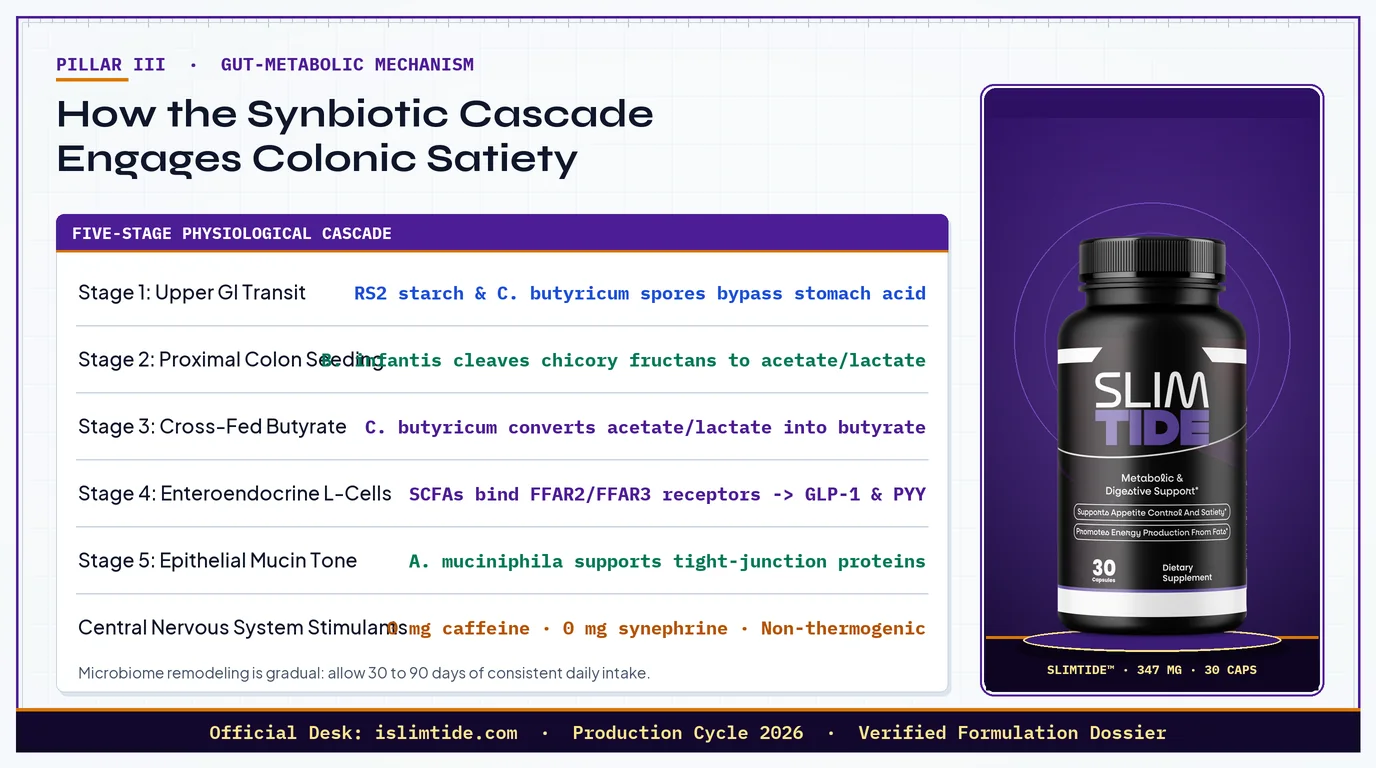
Slimtide is engineered around synergistic co-localization. When the hypromellose capsule hydrates in an 8 oz. glass of water and transits to the ileocecal valve, the 36 mg microbial consortium does not emerge starved into a competitive desert; it is surrounded by an 8.64-to-1 gravimetric cushion (311 mg) of its exact preferred carbon substrates (211 mg beta-2,1 chicory fructans for Bifidobacterium infantis and 100 mg B-type crystalline potato starch for Clostridium butyricum) [1,21,7].
Inspect our full Supplement Facts panel, read Protocol Dossier 07 on SCFA to GLP-1/PYY signaling, or select your direct 3-bottle or 6-bottle Slimtide protocol [23].
Frequently Asked Questions
How is the 347 mg total active dose per Slimtide capsule calculated?
It is the exact arithmetic sum of the three active lines printed on the Supplement Facts panel: 211 mg Chicory Root Inulin + 100 mg Potato Resistant Starch + 36 mg Probiotic Blend = 347 mg of active dietary ingredients per 1-capsule serving [1].
Why doesn't the Slimtide bottle list individual CFU counts for each of the three probiotic strains?
Under U.S. FDA regulation 21 CFR 101.36(b)(3)(ii), the mandatory quantitative declaration for dietary ingredients in a proprietary blend is metric weight (36 mg) with constituents listed in descending order of weight [2,6]. While FDA guidance permits voluntary supplemental CFU listing, Slimtide follows the mandatory gravimetric standard and enforces cold-storage handling instructions to maintain microbial viability [1,6].
What is the prebiotic-to-probiotic weight ratio inside each Slimtide capsule?
Each capsule contains 311 mg of prebiotic fibers (211 mg inulin + 100 mg resistant starch) and 36 mg of the three-strain probiotic blend, yielding an 8.64-to-1 prebiotic-to-probiotic gravimetric ratio (89.63% prebiotic substrate to 10.37% probiotic biomass) [1].
Can I take two or three Slimtide capsules per day for faster results?
No. The official Slimtide label specifies taking one (1) capsule daily with an 8 oz. glass of water and explicitly states: 'Do not exceed the recommended daily dose' [1]. Synbiotic microbiome adaptation is a biological colonization and cross-feeding process driven by daily consistency over 60 to 90 days rather than acute megadosing [20].
Scientific & Regulatory References
Numbered in order of first appearance on this page. Primary peer-reviewed citations link directly to PubMed (NCBI/NLM) and eCFR records verified on November 15, 2026.
- Slimtide Official Supplement Facts Panel (30 Capsules; 211 mg Chicory Root Inulin, 100 mg Potato Resistant Starch, 36 mg Probiotic Blend; Distributed by Instituto Experience, Lakeland FL 33804). Verified November 15, 2026. Official Record
- 21 CFR 101.36. Nutrition labeling of dietary supplements (proprietary blends listed in descending order of predominance by weight). Official Record
- U.S. Food and Drug Administration. Dietary Supplements Overview and Consumer Guidance. Official Record
- 21 CFR Part 111. Current Good Manufacturing Practice in Manufacturing, Packaging, Labeling, or Holding Operations for Dietary Supplements. Official Record
- Slimtide U.S. Fulfillment, Transit & Cold-Storage Guidelines. Verified November 15, 2026. Official Record
- U.S. Food and Drug Administration. Guidance for Industry: Policy Regarding Quantitative Labeling of Dietary Supplements Containing Live Microbials. Official Record
- Stoeva MK, Garcia-So J, Justice N, et al. Butyrate-producing human gut symbiont, Clostridium butyricum, and its role in health and disease. Gut Microbes. 2021;13(1):1-28. PMID 33874858. PubMed
- Depommier C, Everard A, Druart C, et al. Supplementation with Akkermansia muciniphila in overweight and obese human volunteers: a proof-of-concept exploratory study. Nat Med. 2019;25(7):1096-1103. PMID 31263284. PubMed
- Plovier H, Everard A, Druart C, et al. A purified membrane protein from Akkermansia muciniphila or the pasteurized bacterium improves metabolism in obese and diabetic mice. Nat Med. 2017;23(1):107-113. PMID 27892954. PubMed
- Cani PD, Lecourt E, Dewulf EM, et al. Gut microbiota fermentation of prebiotics increases satietogenic and incretin gut peptide production with consequences for appetite sensation and glucose response after a meal. Am J Clin Nutr. 2009;90(5):1236-43. PMID 19776140. PubMed
- Li H, Zhang L, Li J, et al. Resistant starch intake facilitates weight loss in humans by reshaping the gut microbiota. Nat Metab. 2024;6(3):578-597. PMID 38409604. PubMed
- Whorwell PJ, Altringer L, Morel J, et al. Efficacy of an encapsulated probiotic Bifidobacterium infantis 35624 in women with irritable bowel syndrome. Am J Gastroenterol. 2006;101(7):1581-90. PMID 16863564. PubMed
- Perraudeau F, McMurdie P, Bullard J, et al. Improvements to postprandial glucose control in subjects with type 2 diabetes: a multicenter, double blind, randomized placebo-controlled trial of a novel probiotic formulation. BMJ Open Diabetes Res Care. 2020;8(1). PMID 32675291. PubMed
- Guess ND, Dornhorst A, Oliver N, et al. A randomized controlled trial: the effect of inulin on weight management and ectopic fat in subjects with prediabetes. Nutr Metab (Lond). 2015;12:36. PMID 26500686. PubMed
- Li J, Liu F, Luo Y, et al. Differential effects of inulin and fructooligosaccharides on gut microbiota composition and glycemic metabolism in overweight/obese and healthy individuals: a randomized, double-blind clinical trial. BMC Med. 2025;23(1):372. PMID 40598275. PubMed
- Dobranowski PA, Stintzi A. Resistant starch, microbiome, and precision modulation. Gut Microbes. 2021;13(1):1926842. PMID 34275431. PubMed
- Ni Y, Qian L, Siliceo SL, et al. Resistant starch decreases intrahepatic triglycerides in patients with NAFLD via gut microbiome alterations. Cell Metab. 2023;35(9):1530-1547.e8. PMID 37673036. PubMed
- Kato M, Hamazaki Y, Sun S, et al. Clostridium butyricum MIYAIRI 588 Increases the Lifespan and Multiple-Stress Resistance of Caenorhabditis elegans. Nutrients. 2018;10(12). PMID 30563064. PubMed
- Zhao Y, Yang H, Wu P, et al. Akkermansia muciniphila: A promising probiotic against inflammation and metabolic disorders. Virulence. 2024;15(1):2375555. PMID 39192579. PubMed
- Salminen S, Collado MC, Endo A, et al. The International Scientific Association of Probiotics and Prebiotics (ISAPP) consensus statement on the definition and scope of postbiotics. Nat Rev Gastroenterol Hepatol. 2021;18(9):649-667. PMID 33948025. PubMed
- Rivière A, Selak M, Lantin D, et al. Bifidobacteria and Butyrate-Producing Colon Bacteria: Importance and Strategies for Their Stimulation in the Human Gut. Front Microbiol. 2016;7:979. PMID 27446020. PubMed
- Gibson GR, Hutkins R, Sanders ME, et al. Expert consensus document: The International Scientific Association for Probiotics and Prebiotics (ISAPP) consensus statement on the definition and scope of prebiotics. Nat Rev Gastroenterol Hepatol. 2017;14(8):491-502. PMID 28611480. PubMed
- Slimtide Official U.S. Store Package Schedule (2 Bottles $158 + $9.99 S&H; 3 Bottles $207 Free S&H + 6 Bonuses; 6 Bottles $294 Free S&H + 6 Bonuses). Verified November 15, 2026. Official Record