Protocol Dossier 08 · Thermal Viability Kinetics · 2°C to 8°C Storage Standard
Refrigerate for Optimal Quality: Thermal Viability Kinetics of Vegetative Cells vs. Bacterial Spores
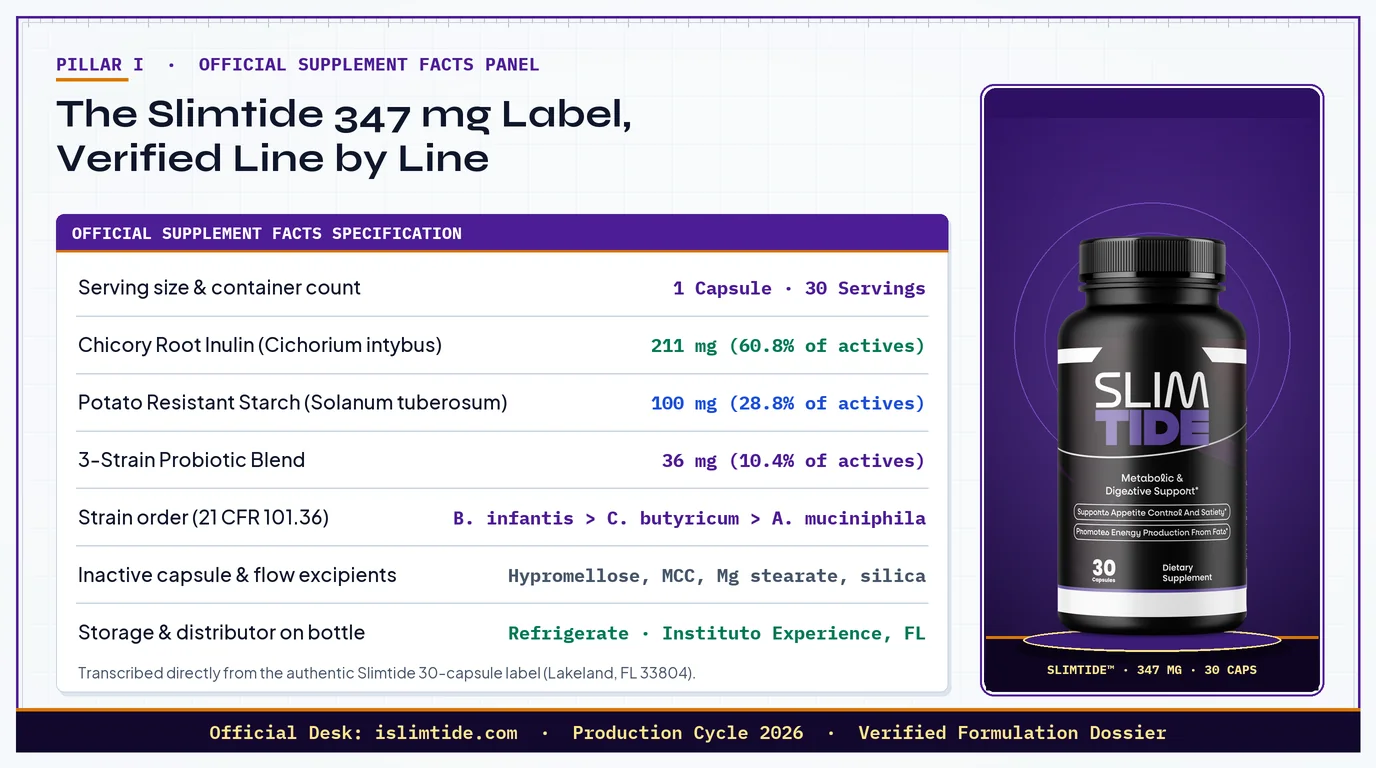
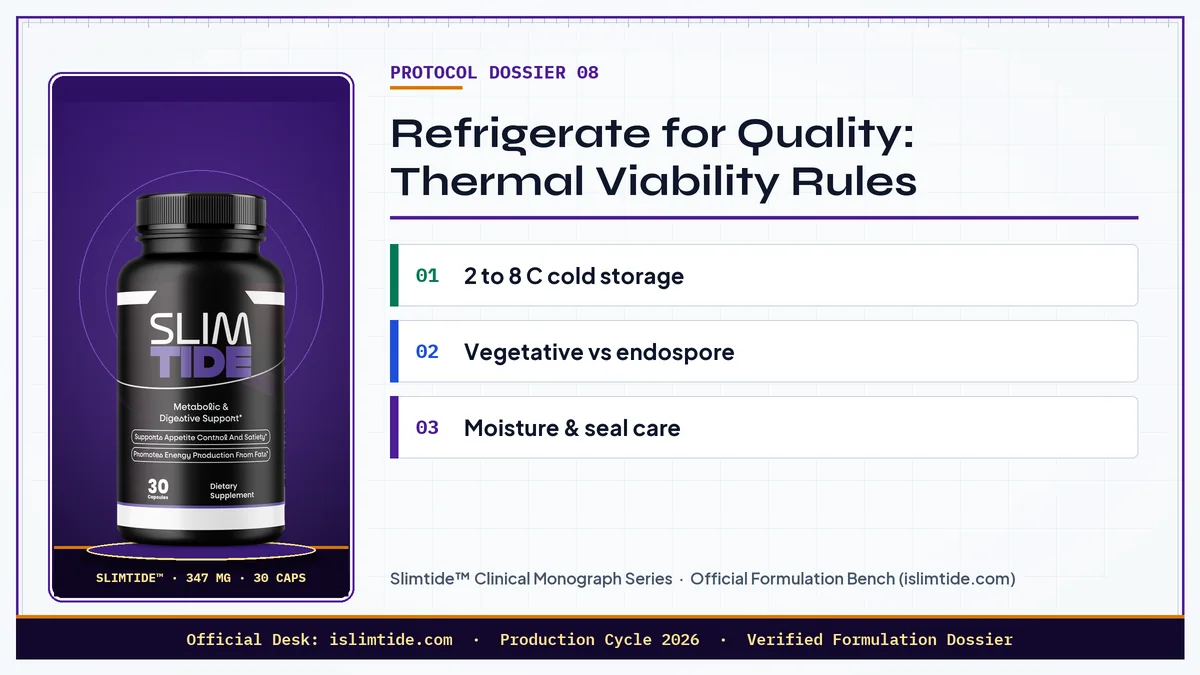
Printed directly on the official Slimtide bottle label is a specific storage directive: 'Refrigerate for optimal quality' alongside 'Keep in a cool, dry place away from heat and light' [1,2]. This technical dossier explains the biophysics of freeze-dried (lyophilized) probiotic survival, why vegetative Bifidobacterium infantis and Akkermansia muciniphila differ thermally from Clostridium butyricum endospores, how sealed domestic transit works, and why kitchen refrigeration (2°C to 8°C) after unsealing prevents moisture-induced viability decay.
Biophysics of Lyophilization & the Glass-Transition State (Tg)
To incorporate live anaerobic bacteria into a dry oral capsule, probiotic cultures undergo lyophilization (freeze-drying): bacterial cells are harvested in stationary phase, suspended in a cryoprotectant matrix, frozen below their eutectic point, and subjected to primary and secondary vacuum sublimation to remove intracellular and extracellular free water [3,4]. When water activity (a_w, defined as the ratio of the vapor pressure of water in the powder to that of pure water) is reduced below a_w < 0.15, the cytoplasm enters an amorphous vitrified glass state below its glass-transition temperature (Tg) [3,2].
In this vitrified state, molecular diffusion, enzymatic autolysis, and lipid peroxidation are arrested by several orders of magnitude. Furthermore, Slimtide encapsulates its 347 mg payload inside a hypromellose (HPMC) vegetarian capsule shell rather than a conventional animal gelatin shell [1]. Standard bovine gelatin capsules contain 13% to 16% equilibrium moisture by weight, which can migrate into dry probiotic powders during storage; hypromellose vegetarian shells contain only 3% to 6% moisture, providing a superior low-humidity microenvironment inside the sealed bottle [1,2].
Official Slimtide Storage & Viability Specifications
- Target Refrigerator Temperature After Opening (35°F to 46°F)
- 2°C to 8°C
- Target Lyophilized Powder Water Activity in Sealed Bottle
- a_w < 0.15
- Equilibrium Moisture of Hypromellose Vegetarian Capsule Shell
- 3% to 6%
- Thermal Stability Ceiling of Amuc_1100 Outer-Membrane Protein
- 70°C Limit
Thermal Divergence Across the Three Slimtide Strains
Why does the Slimtide bottle state "Refrigerate for optimal quality" rather than claiming infinite room-temperature stability, and why does it remain safe during standard 5-to-7 business day U.S. ground shipping? The answer lies in the distinct cellular structures of the three species inside the 36 mg Probiotic Blend [1,5,6]:
- Strain 1: Bifidobacterium infantis (12.0 to 34.0 mg, Vegetative Gram-Positive Actinobacterium): Does not form endospores [7]. In its freeze-dried state inside a factory-induction-sealed bottle, Bifidobacterium infantis tolerates brief ambient transit temperatures (15°C to 25°C / 59°F to 77°F). However, once the bottle is opened daily and exposed to atmospheric oxygen (
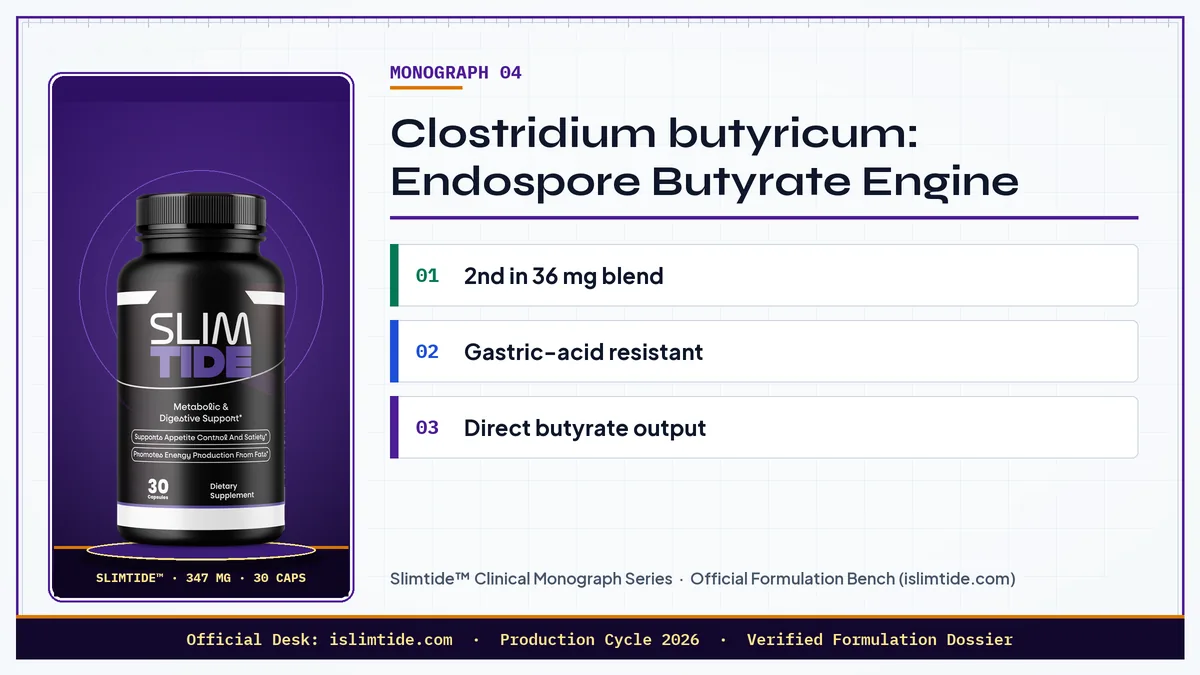
O2) and ambient water vapor, thermal Arrhenius decay accelerates at temperatures above 25°C (77°F) [3,2]. Refrigerating at 2°C to 8°C slows membrane phospholipid oxidation and preserves high vegetative CFU viability across the 30-day bottle cycle. - Strain 2: Clostridium butyricum (0.5 to 17.75 mg, Gram-Positive Endospore Former): Forms metabolically dormant endospores armored by a dehydrated calcium-dipicolinate (
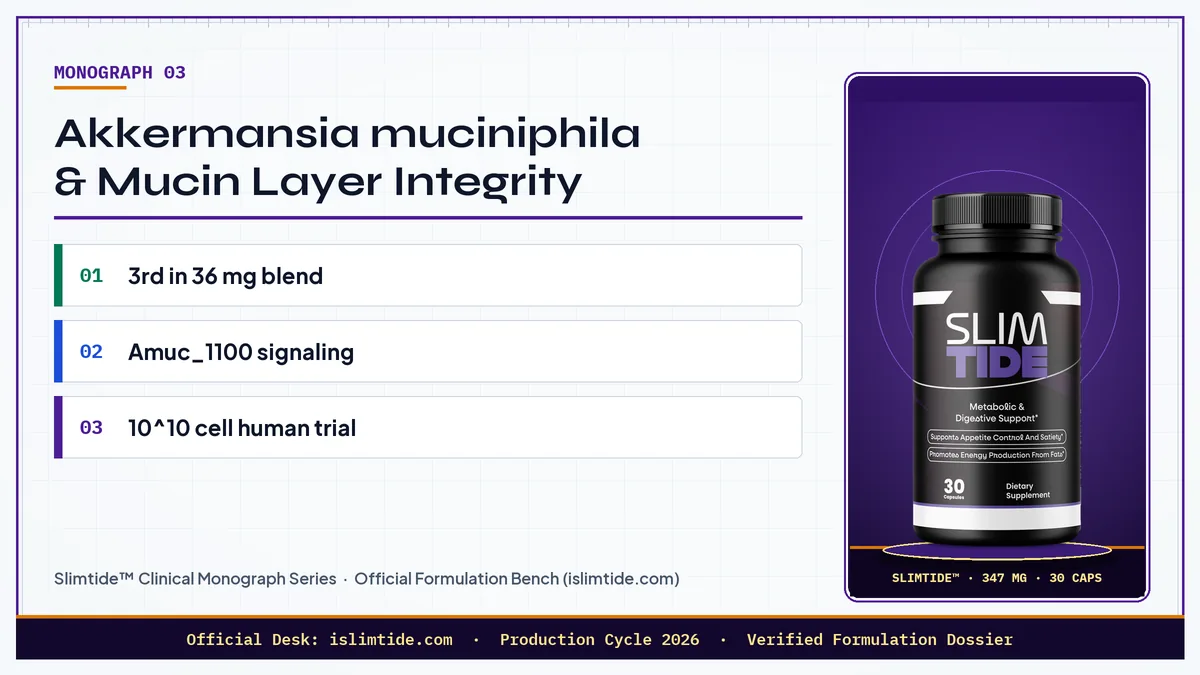
Ca2+-DPA) core, peptidoglycan cortex, and cross-linked protein coat [5,8]. Clostridium butyricum endospores exhibit exceptional resistance to ambient heat, desiccation, oxygen, and gastric acid, remaining viable at room temperature for extended periods provided water activity remains low so premature germination is not triggered inside the capsule [5]. - Strain 3: Akkermansia muciniphila (0.5 to 11.9 mg, Gram-Negative Mucin Symbiont): Does not form endospores and is a strict anaerobe [9,10]. Cold storage at 2°C to 8°C preserves live vegetative cells for active colonic mucin degradation. Simultaneously, as demonstrated by Plovier et al. (2017) and Depommier et al. (2019), its key outer-membrane signaling protein Amuc_1100 remains conformationally intact and bioactive at temperatures up to 70°C (158°F) [6,11]. This dual profile means transit warmth never destroys Amuc_1100 TLR2 barrier signaling, while post-opening refrigeration protects live cell culturability!
| Formula Component | Structural State in Capsule | Sealed U.S. Transit Resilience (5-7 Days) | Sensitivity to Open-Bottle Heat & Humidity (>25°C / >60% RH) | Benefit of 2°C-8°C Refrigeration After Opening |
|---|---|---|---|---|
| Bifidobacterium infantis (1st in blend) | Lyophilized vegetative rod | High when factory-sealed with desiccant | High (oxygen + moisture lowers glass transition Tg) | Preserves vegetative membrane integrity & GH32 enzyme activity [12] |
| Clostridium butyricum (2nd in blend) | Dormant Ca-DPA endospore | Very High (heat & acid resistant spore) | Low to moderate (high humidity can trigger premature hydration) | Keeps spores dormant until cecal transit [5] |
| Akkermansia muciniphila (3rd in blend) | Lyophilized vegetative oval + Amuc_1100 | Live cells protected by seal; Amuc_1100 stable to 70°C | High for live anaerobic culturability; Low for Amuc_1100 protein | Maximizes live mucin-fermenting fraction alongside Amuc_1100 [6,11] |
| Chicory Root Inulin (211 mg) | Dry amorphous beta-(2,1) fructan powder | Very High (chemically stable carbohydrate) | Hygroscopic (absorbs moisture and clumps if left unsealed) | Prevents powder clumping when cap is sealed tightly [13] |
| Potato Resistant Starch (100 mg) | Native B-type crystalline RS2 granule | Very High below 55°C (gelatinizes >58°C in water) | Stable in dry air; never mix into hot liquids (>60°C) | Maintains native B-type crystal hydration stability [14] |
Arrhenius Thermal Decay & Water Activity (a_w) Kinetics
In pharmaceutical microbiology, the rate constant k of vegetative probiotic viability loss over time follows the Arrhenius equation coupled with water-activity plasticization [3]:
This biophysics explains why where you open your bottle matters just as much as temperature. A steamy bathroom medicine cabinet combines the two worst enemies of lyophilized synbiotics: repeated warm thermal spikes from hot showers and 70% to 90% relative humidity [2].
Official 5-Step Cold-Storage & Multi-Bottle Inventory Protocol
Whether you order the 2-bottle starter pack (60 days), the 3-bottle protocol (90 days), or the 6-bottle supply (180 days), follow our official laboratory storage SOP from the moment your package arrives from our U.S. fulfillment center [2,1]:
For complete domestic shipping timelines and carrier details, visit our Official U.S. Shipping & Storage Policy or verify your authentic direct bottle here [2].
Frequently Asked Questions
Does Slimtide ship in refrigerated cold-packs, or is standard U.S. shipping safe?
Slimtide ships via standard domestic U.S. carriers (5 to 7 business days) in factory-induction-sealed bottles containing a food-grade desiccant [2]. Before the foil seal is broken, the low water activity (a_w < 0.15), hypromellose vegetarian shell, dormant Clostridium butyricum endospores, and heat-stable Amuc_1100 protein (stable up to 70°C) protect the formula during transit [5,6]. Refrigeration is specifically required after opening to protect the capsules from daily air and humidity exposure over 30 days [1].
Can I store Slimtide in the freezer to make it last even longer?
No. Do not freeze Slimtide capsules [2]. While commercial lyophilization uses controlled ultra-low vacuum freezing, placing finished capsules in a household freezer (-18°C / 0°F) causes condensation when the bottle is taken out to remove a capsule, leading to ice-crystal damage and hypromellose shell brittleness. Standard refrigerator temperatures (2°C to 8°C / 35°F to 46°F) are ideal [1].
Why is chicory root inulin sensitive to humidity if it is a fiber, not a live bacteria?
Chicory root inulin (Cichorium intybus fructans) is naturally hygroscopic, meaning its hydroxyl groups attract water molecules from humid air [13]. If a bottle is left uncapped in a humid bathroom, the inulin powder can absorb moisture, clump inside the capsule, and transfer that moisture to the adjacent probiotic cells. Keeping the bottle capped and refrigerated prevents moisture uptake [2].
How should I store bottles 2 through 6 when I order the 6-bottle package?
Keep bottles 2 through 6 unopened with their factory foil induction seals intact until you finish each preceding 30-day bottle [2]. You may store those sealed backup bottles in the back of your refrigerator (2°C to 8°C) or in a cool, dark, climate-controlled closet away from kitchen ovens and direct sunlight [1,2].
Scientific & Regulatory References
Numbered in order of first appearance on this page. Primary peer-reviewed citations link directly to PubMed (NCBI/NLM) and eCFR records verified on November 15, 2026.
- Slimtide Official Supplement Facts Panel (30 Capsules; 211 mg Chicory Root Inulin, 100 mg Potato Resistant Starch, 36 mg Probiotic Blend; Distributed by Instituto Experience, Lakeland FL 33804). Verified November 15, 2026. Official Record
- Slimtide U.S. Fulfillment, Transit & Cold-Storage Guidelines. Verified November 15, 2026. Official Record
- NIH Office of Dietary Supplements. Probiotics: Fact Sheet for Health Professionals. Official Record
- Salminen S, Collado MC, Endo A, et al. The International Scientific Association of Probiotics and Prebiotics (ISAPP) consensus statement on the definition and scope of postbiotics. Nat Rev Gastroenterol Hepatol. 2021;18(9):649-667. PMID 33948025. PubMed
- Stoeva MK, Garcia-So J, Justice N, et al. Butyrate-producing human gut symbiont, Clostridium butyricum, and its role in health and disease. Gut Microbes. 2021;13(1):1-28. PMID 33874858. PubMed
- Plovier H, Everard A, Druart C, et al. A purified membrane protein from Akkermansia muciniphila or the pasteurized bacterium improves metabolism in obese and diabetic mice. Nat Med. 2017;23(1):107-113. PMID 27892954. PubMed
- Henrick BM, Rodriguez L, Lakshmikanth T, et al. Bifidobacteria-mediated immune system imprinting early in life. Cell. 2021;184(15):3884-3898.e11. PMID 34143954. PubMed
- Kato M, Hamazaki Y, Sun S, et al. Clostridium butyricum MIYAIRI 588 Increases the Lifespan and Multiple-Stress Resistance of Caenorhabditis elegans. Nutrients. 2018;10(12). PMID 30563064. PubMed
- Derrien M, Vaughan EE, Plugge CM, et al. Akkermansia muciniphila gen. nov., sp. nov., a human intestinal mucin-degrading bacterium. Int J Syst Evol Microbiol. 2004;54(Pt 5):1469-1476. PMID 15388697. PubMed
- Cani PD, Depommier C, Derrien M, et al. Akkermansia muciniphila: paradigm for next-generation beneficial microorganisms. Nat Rev Gastroenterol Hepatol. 2022;19(10):625-637. PMID 35641786. PubMed
- Depommier C, Everard A, Druart C, et al. Supplementation with Akkermansia muciniphila in overweight and obese human volunteers: a proof-of-concept exploratory study. Nat Med. 2019;25(7):1096-1103. PMID 31263284. PubMed
- Rivière A, Selak M, Lantin D, et al. Bifidobacteria and Butyrate-Producing Colon Bacteria: Importance and Strategies for Their Stimulation in the Human Gut. Front Microbiol. 2016;7:979. PMID 27446020. PubMed
- Gibson GR, Hutkins R, Sanders ME, et al. Expert consensus document: The International Scientific Association for Probiotics and Prebiotics (ISAPP) consensus statement on the definition and scope of prebiotics. Nat Rev Gastroenterol Hepatol. 2017;14(8):491-502. PMID 28611480. PubMed
- Raigond P, Ezekiel R, Raigond B. Resistant starch in food: a review. J Sci Food Agric. 2015;95(10):1968-78. PMID 25331334. PubMed